

Xylo Bio’s Neuroscience Newsletter February 2026
Neuroanatomy 101

It can be overwhelming to think about how all the different brain areas and cells interact to create a moving, breathing and thinking person. From the cerebral cortex to the cerebellum, understanding how the brain is organized helps us determine which areas to focus on when creating novel neurotherapeutics.
Science in Sixty Seconds
Neuroanatomy 101
The brain is a highly sophisticated organ containing approximately 86 billion neurons that communicate with each other constantly. Knowing where and what type of these neurons are is important for understanding the functions they support and how to engage these areas when things aren’t working properly.
Brain organization was previously thought to be based on the size and shape of the head, with various behaviors and personality traits associated with bumps or divots in the skull. This idea was referred to as phrenology and, with the advancement of 19th century neuroscience, was disregarded and is now considered pseudoscience (Simpson, 2005). By using techniques that disrupted brain tissue, including ablation and lesions, or assessing case studies of people with brain lesions, scientists began to uncover that different parts of the brain were responsible for different actions. For example, abnormalities in the frontal lobe of speech-impaired patients led to the discovery of Broca’s Area, which we now know is necessary for speech (Stinnett TJ et al., 2023). Fast forward to today, advanced neuroimaging techniques allow us to visualize the brain at 100-micron resolution.
The Brain Breakdown
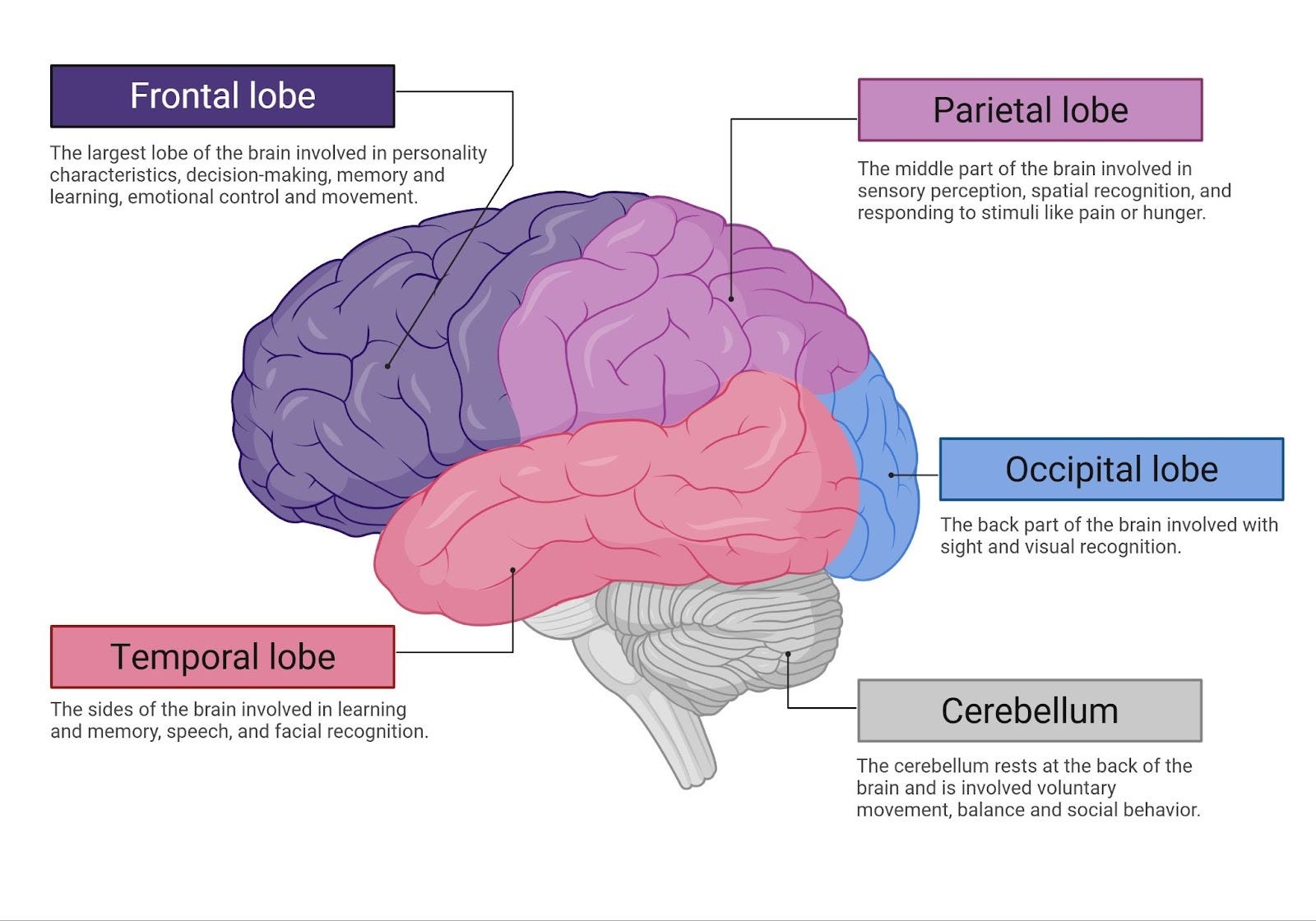
The human brain can be organized multiple ways, but at the highest level it can be divided into the cerebrum (or cerebral cortex), cerebellum, and brainstem. Most neurons - around 69 billion - are located in the cerebellum and about 16 billion in the cerebral cortex (Azevedo et al., 2009). Each brain region can be further divided into increasingly specific subregions. For example, the cerebral cortex has two hemispheres which contain four sections (lobes), each associated with distinct functions and microcircuits relevant to behaviors and neuropsychiatric disorders (See Figure 1; made with BioRender).
If we zoom deeper into the brain, there are also highly important subcortical structures that communicate with neurons across the cerebral cortex. Many of these regions belong to the mesolimbic system, often called the brain’s reward system, because its signaling plays a central role in emotional processing, motivation, and natural reward. Several of these structures are highlighted in Figure 2 (made with BioRender).
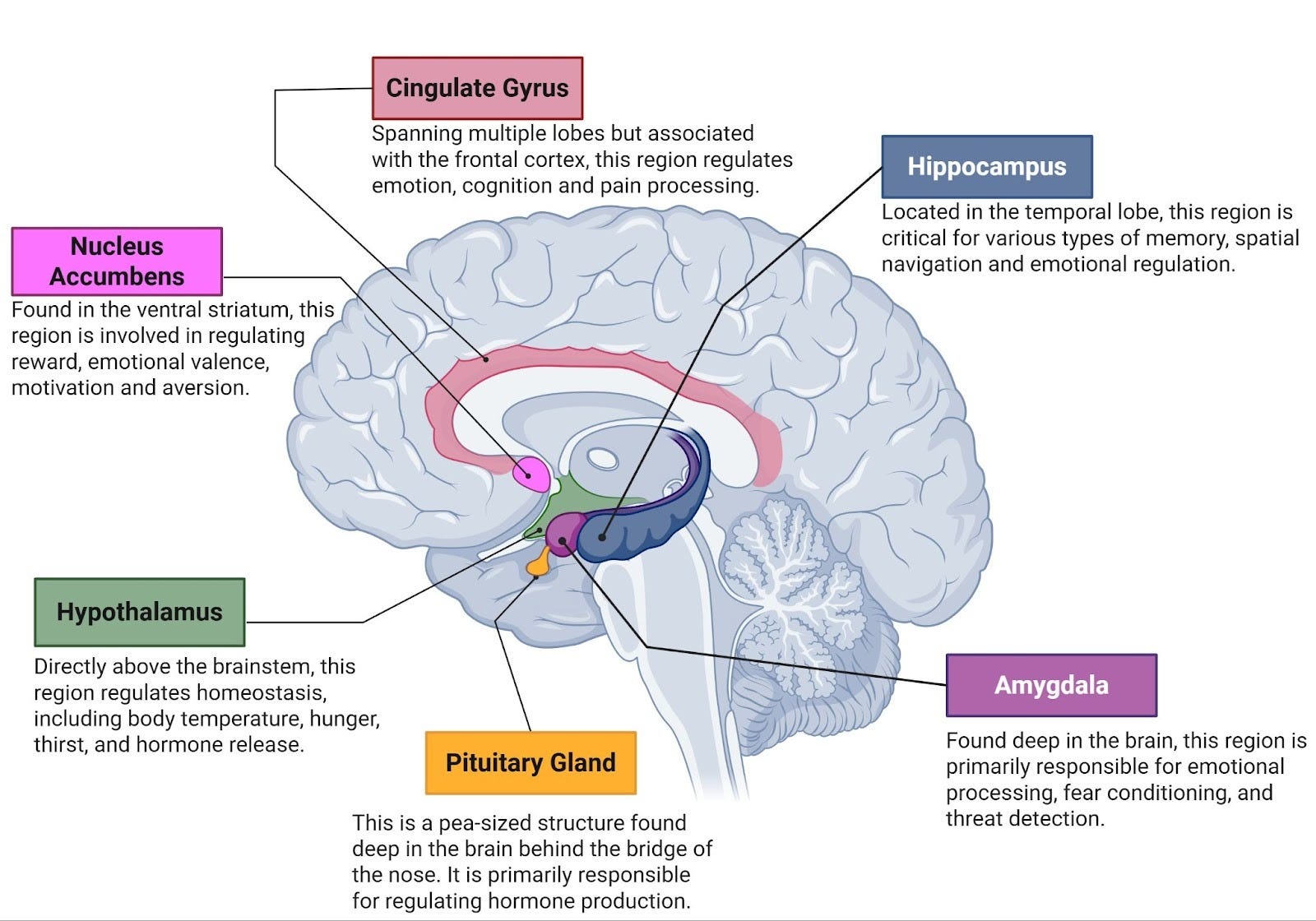
All of these brain regions are extremely important for daily functioning, but disruptions in their normal activity - such as extreme stress, traumatic experiences, or changes in neurotransmission - can cause symptoms of neuropsychiatric disorders.
For example:
In the frontal cortex, regions like the prefrontal and cingulate cortices are implicated in the pathophysiology of several neuropsychiatric disorders, including depression, schizophrenia, and substance use disorders.
In the temporal lobe, structures such as the hippocampus and amygdala are strongly linked to anxiety, post-traumatic stress disorder (PTSD), and cognitive decline.
Neurotherapeutics have come a long way, and scientists are increasingly combining advanced technologies – such as CRISPR-based gene editing, bioavailability engineering, and rational small-molecule design – to create drugs that act with much greater brain-region specificity. CRISPR tools make it possible to identify and validate the exact genes, receptors, and circuits driving disease in defined neural regions and harnessing these tools can direct pharmaceuticals directly to the target. Further, advances in medicinal chemistry enable the design of small molecules with finely tuned brain penetration, receptor selectivity, and signaling bias that allow them to engage specific brain circuits involved in disease.
At Xylo Bio, we know the brain is complex and every region matters. To move the field toward precision medicine, we must first understand how these brain areas communicate with each other. With this knowledge, we can translate deep biological insight into precisely targeted therapies that modulate the right pathways, in the right cells, at the right time. By aligning cutting-edge technology with a circuit- and mechanism-focused view of brain disorders, we are designing first-in-class therapies that moves neuropsychiatric drug development away from broad, systemic effects and toward more effective, durable, and patient-centered treatments.
XYLO BIO UPDATES:
Scientific Leadership
We have been busy building out an incredible Clinical Advisory Board. Here are our newest additions to our team of incredible advisors:
Dr. Jens Wendland, a German-trained physician and expert of serotonin transporters, neuroscience and translational medicine. He is currently CMO of Kynexis Therapeutics.
Dr. John Harrison, a cognition expert who has served as CSO for multiple companies focused on translational neuroscience, including Scottish Brain Sciences, and currently Neurotrack Inc.
Dr. Raymond Sanchez, a psychiatrist who served as CMO of Cerevel Therapeutics, before its acquisition by Abbvie, and focused on the global development of novel and innovative treatments.
Dr. Maurizio Fava, a psychiatrist focused on clinical and psychopharmacology research. He is currently Chair of the Mass General Brigham Psychiatry Department.
Dr. Matthias Leitchi, an attending physician and head of the psychopharmacology research group at the Department of Biomedicine of the University Hospital, with expertise in psychedelics, CNS drug development and translational research.
To see all of the Xylosiders on the advisory board, please visit our Team Page.
Collaborations and Thought Leadership
Josh Ismin (CEO), Samantha Rector (previously Tabone; Director of Business Development) and Jack Nguyen (VP of Research and Development) attended the J.P. Morgan Healthcare Conference and met with several colleagues, investors and collaborators.
Dr. Sam Banister (CSO) attended the American College of Neuropsychopharmacology Annual Meeting, reconnecting with some of our advisors and collaborators including Dr. Alex Kwan.
Dr. Alaina Jaster (Head of Communications) co-hosted a workshop on how to communicate science to a variety of audiences and across social media at the Winter Conference for Brain Research.
Dr. Sam Banister (CSO) chatted with headache expert and neuroscientist, Dr. Emmanuelle Schindler, on the latest Xylo Bio Targeted Neuro Talks episode:
Coming Up:
Find members of the Xylo Bio team at these upcoming conferences in neuroscience, technology drug discovery and healthcare.
One Mind Accelerator (Palo Alto, USA, February 10) – Samantha Rector (VP of Business Development) will be participating in the biopharma roundtable and networking event.
Psychedelic Therapeutics and Drug Development Conference (New Orleans, USA, February 26-27) – Dr. Sam Banister (CSO) will be presenting on biomarker guided research alongside Dr. Mark Rasenick (CSO of PAX Neuroscience, Inc.) and Dr. Ryan Field (CEO of Kernel).
International Society for Research on Psychedelics (ISRP) (New Orleans, USA, February 27-March 1) – Dr. Sam Banister (CSO) will be presenting data from our collaboration with USyd Pharmacologist, Dr. Nick Everett. Dr. Alaina Jaster (Head of Comms) will be presenting on psychedelic, DOI, and its impact on preclinical research.
Photos

RESEARCH UPDATES: Science Shaping the Future of Neurotherapeutics
This month’s emerging literature demonstrates the same principles driving Xylo’s strategy: mechanism-guided design, rigorous biological investigation and clinically scalable innovation.
Preclinical Research
New luminescence-based assay to identify functional activity of 5-HT2A receptors | In vitro assays measuring Gq signaling, including assessment of the PLC-β interaction, are important to drug discovery, but have limitations. This luminescence-based method builds upon existing Gq-PLB-β assays but combines optimal positioning and smaller luciferase enzymes. Overall, the Gαq-PLC-β assay yielded data that correlated with those obtained with the IP1 accumulation and mini-Gαq recruitment assays and allowed detection from endogenously expressed GPCRs. Pharmacol. Res.
Corticotropin-releasing neurons in specific brain regions have sex-specific effects on anxiety | This study found that a key stress-related brain circuit influences fear and anxiety differently in males and females, and in females its effects change across the reproductive cycle. When hormone levels were low, females showed more persistent anxiety-like responses to unpredictable threats, similar to patterns seen in PTSD. The results help explain sex differences in anxiety disorders and point to brain targets that could guide more tailored treatments. Biol. Psychiatry.
Assessment of Psilocybin in rodent pain models yield null results | Preclinical data suggests that psychedelics may be useful in treating pain. This study used models of inflammatory pain, neuropathic pain and muscle pain to assess the direct analgesic properties of a single dose of psilocybin.They measured psilocybin’s effects in acute and post-acute time points in a variety of behavioral measures, but only found a reduction in cold sensitivity following psilocybin that was unrelated to induced-inflammatory pain. Nat. Commun.
Modification of psilocin produces weaker hallucinogenic responses | Researchers designed modified versions of psilocin using fluorinated N-alkyl carbamate derivatives that carefully control how much of the active drug is released in the body and brain. These compounds still interact with important serotonin receptors linked to therapeutic effects but produce reduced hallucinogenic responses compared to psilocybin. The work shows a strategy for fine-tuning psychedelic-related drugs to balance clinical benefit with fewer acute psychoactive effects. J. Med. Chem.
Stereoselectivity of MDMA reveals partial agonism at 5-HT2A receptor | MDMA is widely thought to produce changes in sensory processing in ways distinct from other classical psychedelics. Using in vitro and in vivo methods, the authors determined that racemic and S(+)-MDMA exhibit weak partial agonism at the 5-HT2A receptor, dose dependent increases in head twitch response, IP1 accumulation, and was able to increase dendritic spine density. Some of these effects were reported to be sex-specific. Neuropsychopharmacol.
Clinical Research
Serotonin and histamine activity involved in non-motor symptoms of Parkinson’s Disease | This study found that in early Parkinson’s disease, non-motor symptoms like depression, anxiety, and REM sleep behavior disorder are linked to reduced function in serotonin- and histamine-related brain regions such as the ventral striatum and dorsal raphe nucleus. They found lower monoamine transporter binding predicted worse depression and anxiety years later, suggesting these chemical signaling changes precede symptom progression. The results map distinct neurotransmitter networks underlying different non-motor symptoms, highlighting potential targets for earlier and more tailored treatments. Mov Disord.
Cortical glutamate signatures may be related to schizophrenia onset | This cross-sectional study found that glutamate levels in the medial prefrontal cortex are significantly elevated in people experiencing their first episode of psychosis who have never been treated, compared with both matched healthy controls and never-medicated individuals with chronic schizophrenia. The findings suggest that this early, untreated phase of psychotic illness may be marked by increased glutamatergic activity, which could inform stage-specific targets for future treatments. JAMA.
Genetic factors involved in neurogenesis may be linked to neuropsychiatric disorder development | This study mapped genetic regulatory networks that control how human radial glia stem cells decide what type of brain cell to become during early cortical neurogenesis. They used single-cell CRISPR methods to identify relevant transcription factors – like ZNF219, NR2E1, and ARX – that influence the balance between neuron and glia production and uncovered downstream genes linked to neurodevelopmental and neuropsychiatric disorders. Nature.
Specific hippocampal activity involved directly in memory consolidation | The study shows that sleep-associated hippocampal sharp-wave ripples (SWRs) play a causal role in memory consolidation. Specifically, during sleep, coordinated bursts of brain activity in the hippocampus work together with slower cortical rhythms to reorganize memories. This process selectively strengthens memories that are behaviorally important while weakening less relevant ones, revealing how sleep actively refines memory rather than simply preserving it. PLoS Biol.
Correlations between magnesium-ibogaine experiences and PTSD symptom reduction | This study found that in veterans with traumatic brain injury and PTSD, more intense mystical-type experiences during magnesium-ibogaine treatment were linked with greater reductions in PTSD symptoms both immediately and one month later, suggesting that the subjective effects of this atypical psychedelic may play a role in its therapeutic impact. It also observed that stronger mystical experiences were associated with sustained changes in brain activity measures, such as shifts in peak alpha frequency in EEG. J. Affect. Disord.
Editorials and Reviews
Brain Neuroplasticity Mechanisms in Psychiatric Illnesses and in the Development of Novel Treatments | This review argues that many psychiatric disorders are best understood as disorders of maladaptive neuroplasticity, which involves disrupted synaptic, cellular, and circuit-level brain changes. The authors discuss how both illness progression and treatment response often reflect alterations in brain plasticity, with therapies ranging from antidepressants to brain stimulation working in part by restoring or redirecting these plastic processes. The authors emphasize the need for better tools to directly measure plasticity in humans and treatments that more precisely target beneficial forms of neural rewiring. Am. J. Psychiatry.
A Meta-Analysis of the Effects of Chronic Stress on the Prefrontal Transcriptome | This meta-analysis reports that chronic stress consistently alters gene expression in the prefrontal cortex across multiple animal studies, particularly downregulating genes linked to glial cells and vascular functions while suppressing markers of neuronal activity. These transcriptional changes mirror signatures associated with psychiatric disorders in humans, suggesting shared biological pathways that may help explain how prolonged stress contributes to mental health conditions such as depression and anxiety. Brain Behav.
Advancing CNS Drug Development: the Transformative Role of Neuroimaging in Translational Medicine | This review focuses on the use of MRI, PET, and SPECT in drug development pipelines – from early discovery and understanding disease biology to patient selection and monitoring. It explains that these technologies provide quantifiable data that can help bridge basic and clinical research, and reduce the risk of late-stage clinical failures in disorders such as Alzheimer’s, Parkinson’s, depression, and schizophrenia. Regen. Eng. Transl. Med.
A structural overview of G-protein-coupled receptors in neurological disorders | This review explains how GPCRs – especially serotonin, dopamine, and corticotropin receptors – change shape when they interact with G-proteins and arrestins, and how these structural changes influence brain function and disease. By comparing detailed structures of multiple GPCR subtypes, the authors show how subtle differences drive signaling specificity in neuropsychiatric and neurodegenerative disorders. These insights support the design of more precise, “biased” drugs that target specific signaling pathways rather than broadly activating or blocking receptors. Acta Pharmacol Sin.
Sanitizing psychedelics: the biopolitics of non-hallucinogenic psychoplastogens | This article critically examines the rise of non-hallucinogenic drugs designed to promote brain plasticity without inducing psychedelic experiences. The author compares and contrasts the shift toward experience-free models of mental health treatment and psychedelic-assisted therapy, which treats subjective experience and emotional confrontation as central to healing. BioSocieties.
Clinical Trial Registrations
Below we highlight some of the newer clinical trial registrations via clinicaltrials.gov.
Biomarker Study | Major Depressive Disorder (N=204) | Neurobiological and Genomic Predictors of Relapse in Depression (MDD) | Sponsor: Mehmet Kemal Arikan, Uskudar University | NCT07328373
Lumateperone 42 mg | Major Depressive Disorder (N=50) | Neurocircuitry Mechanisms and Efficacy of Lumateperone as Adjunctive Therapy for Major Depressive Disorder and History of Early Life Abuse (ITI-ELA-MDD) | Sponsor: Julie Farrington, University of Texas at Austin | NCT07369115
Esketamine 0.3 mg/kg | Severe Depression (N=242) | Effect of Esketamine on Perioperative Negative Emotions in Breast Cancer Surgery Patients With Severe Depression | Sponsor: Weidong Mi, Chinese PLA General Hospital | NCT07374211
Jump back to:
Science in Sixty Seconds – Exploring the last year of neurotherapeutics
Xylo Bio Updates – Company news, progress, and highlights
Research Updates – Summaries of recent studies shaping the field
Thanks for reading Xylo Bio’s Neuroscience Newsletter! Subscribe to stay informed.