

Xylo Bio’s Neuroscience Newsletter August 2026
Processing & Perceiving Pain

Pain feels simple — you touch something hot, it hurts, and you pull away. But the biology behind it is more complex. This month, we’re tracing the pain signal from nerve to brain, and asking a bigger question along the way: what if some of the most promising new pain therapies aren’t targeting pain itself, but the volume knob that controls how loud it gets?
Science in Sixty Seconds
How is pain processed?
We have all experienced some form of physical pain, whether it’s a stubbed toe, the acute burn from touching a hot pan, or prolonged muscle strain. These different types of pain aren’t just rooted in their duration or cause, but are distinguished by the way our brain processes them.
Our bodies have a unique way of processing sensory stimuli, which includes pain. The sequence of events leading to pain perception starts with transmission of pain, where stimuli (or the pain event) produce nerve impulses in the primary neurons responsible for transmitting pain to the brain, known as nociceptors. The nociceptors then send the signals to nerve fibers, either the A-delta fibers or the C fibers (Yam et al. 2018).
There are two speeds that pain can be processed. The fast ones deliver the “ouch!” message the instant you stub your toe via A-delta fibers. The slow one (via C fibers) delivers the dull throb that shows up after and maybe lasts a little longer. Despite their speed, both messages get sent to the spinal cord where central pain-transmission cells act as a switchboard before passing it along to the brain. In the brain, the message gets sent to various brain regions, including the thalamus which is responsible for the perception of pain. From the thalamus, the signals can get sent to the somatosensory cortex to figure out where the pain is and the frontal cortex to figure out how awful or urgent the pain is (Yam et al. 2018; Figure 1).
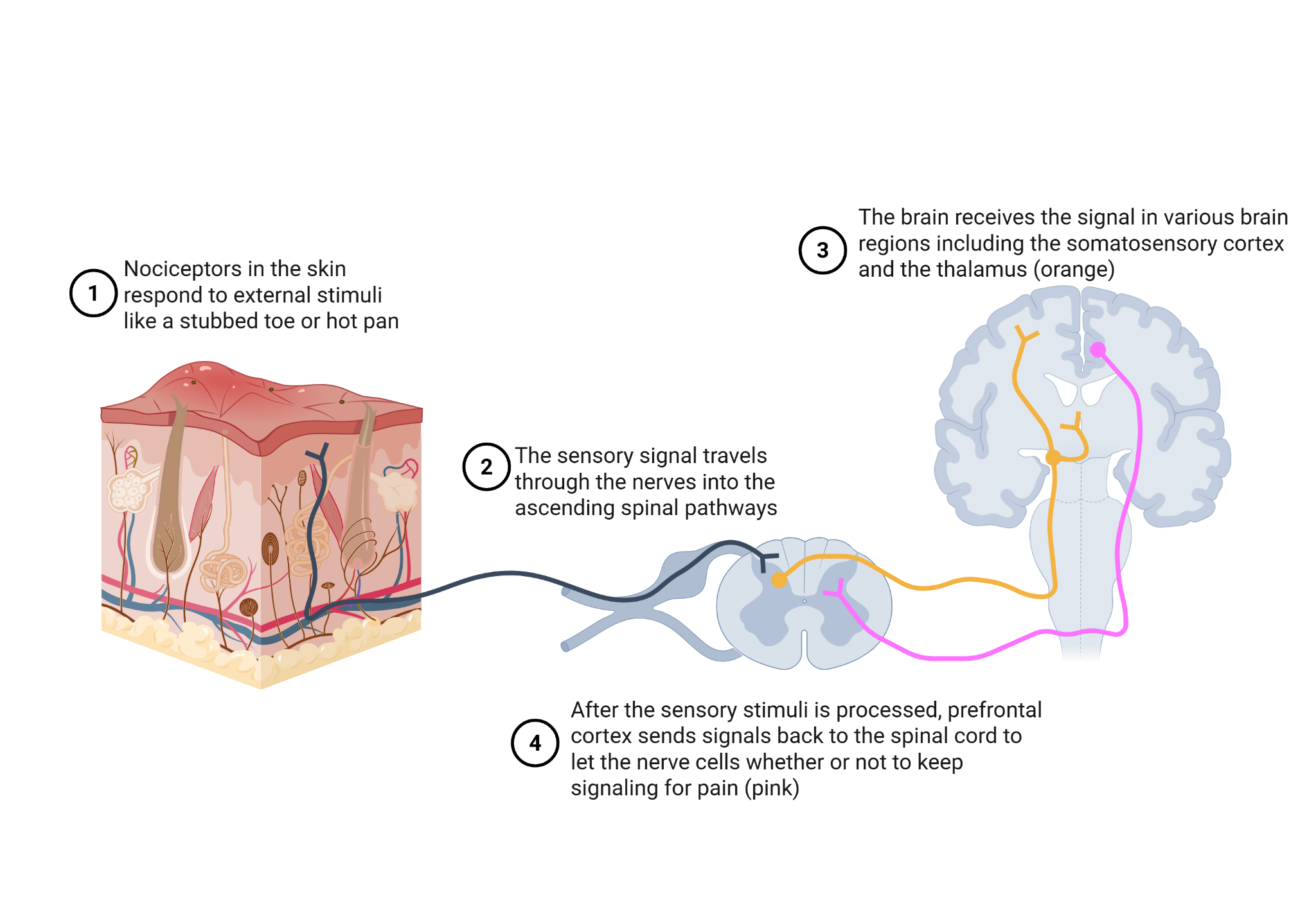
After all that, the brain has to respond to the message accordingly. After the frontal cortex processes the pain signals, it sends a response back to the spinal cord which adjusts if more pain signaling is needed, acting as a volume control knob for the level of pain we feel.
The Different Kinds of Pain
Pain is most commonly classified by duration – is the pain acute or chronic? But it’s also classified by the pathophysiology underlying the pain. This typically classifies pain into nociceptive, neuropathic and nociplastic (Behrands, 2026; Figure 2):
Nociceptive acts as a response to actual or threatened damage to non-neural tissue, such as injuries, physical trauma or surgery. This can be somatic (mechanical pressure, hot/cold, or chemical stimulation) or visceral (organ, muscles, or bones).
Neuropathic happens as a direct result of disease or serious injury affecting peripheral or central nerve cells such as neuropathy caused by diabetes or chemotherapy. This is often categorized as chronic pain.
Nociplastic arises from altered nociception despite no clear evidence of damage to tissue, nerve damage or otherwise. This is also referred to as idiopathic pain.
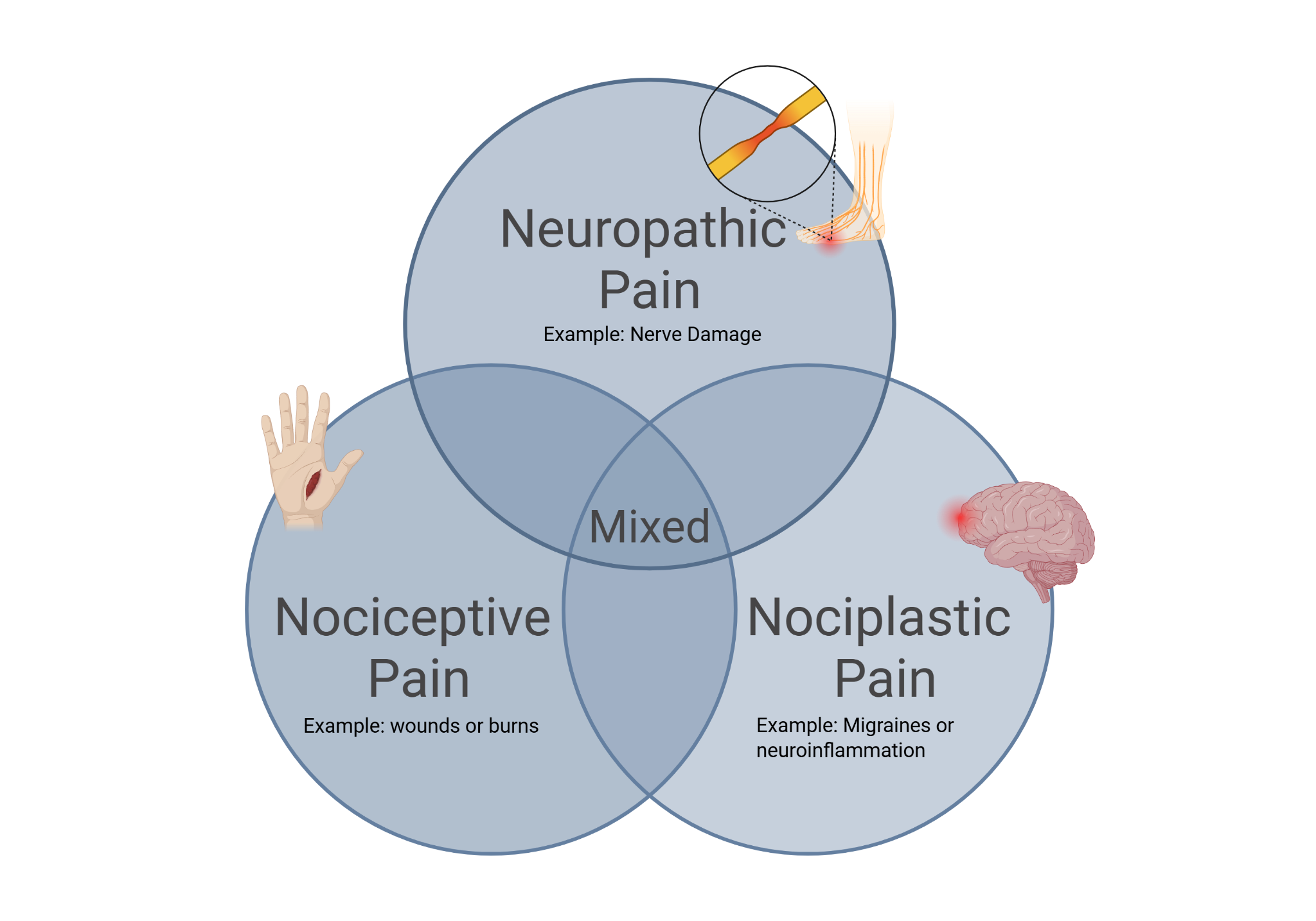
Unfortunately, pain is complex and people can experience symptoms across these categories. This is referred to as “mixed”pain. Patients with fibromyalgia often experience real, severe and widespread pain but medical doctors haven’t been able to identify damaged tissue or injury to explain it. The best current explanation is that the volume of the pain has been turned up and the knob is stuck and drugs for pain usually target specific mechanisms not the point of pain perception.
Does serotonin control the volume?
Researchers and medical professionals have been on the search for better pain treatments, especially for those suffering from mixed pain or diseases like fibromyalgia. Some of these professionals have turned to serotonin for answers, as it may act as the volume control for pain perception.
But serotonin’s role in pain is complicated. With over a dozen different receptors distributed across the peripheral and central nervous system, it’s difficult to parse out whether serotonin is helping or hurting (literally).
Classical psychedelics like psilocybin are thought to work primarily through activation of serotonin 2A (5-HT2A) receptors, but the effects on pain are more complex. In acute antinociception models of thermal or mechanical sensitivity, psychedelics don’t exhibit classic acute pain-relieving properties (Gregory et al. 2025) and in some cases enhance nociception (Abbott et al. 1996), but in chronic pain models single or repeated doses have been reported to produce effects up to weeks or months (Kolbman et al. 2023; Koseli et al. 2025; Askey et al. 2026). These preclinical findings implicate the serotonin-immune pathway, suggesting that 5-HT2A receptor activation promotes neuroplasticity and downregulates pro-inflammatory pathways.
Patients are also interested in using serotonergic substances for treating their pain. In a study surveying people in North America with fibromyalgia, 36.8% of individuals reported benefit from psychedelic use. Of those who reported using psychedelics with the intention of treating chronic pain, 11 of 12 reported improved symptoms (Glynos et al. 2023). A recent open label pilot study (n=5) assessed psilocybin for fibromyalgia but was halted mid-study. However, in the small sample, participants reported clinically meaningful improvements in pain severity, pain interference and sleep disturbance following treatment (Aday et al. 2025), supporting further research into this complex disease.
While the science is still inconclusive, serotonergic substances have the ability to act as neuromodulators rather than just pain suppressors, which may help inform some of the mechanistic questions. 5-HT2A receptors are largely expressed in the prefrontal cortex, which is the hub for attention, mood, expectation and pain processing (Hammo et al. 2025). All of these factors influence pain perception and serotonin is in the center of it all, so the question is whether these compounds are reducing pain itself, or rather the perception of the pain.
Why this matters for Xylo Bio
The emerging role of serotonin receptor activity in pain perception provides new avenues for novel therapeutics. Rather than attempting to temporarily suppress pain through acute analgesia, future therapies must impact the neural circuit that processes and amplifies those signals.
We know that chronic pain can hijack the system and crank the volume all the way up. By understanding how serotonin receptors influence both pain after physical injury and the circuit involved in signaling pain intensity, complex biology becomes a scalable way to provide lasting relief. A drug that leaves pain intensity unchanged while cutting how much pain interferes with someone’s life isn’t a failed painkiller. It’s just a different kind of pain relief.
XYLO BIO UPDATES:
Collaborations and Thought Leadership
Xylo Bio leadership including members of Research & Development, Business Development and Clinical Operations had an off-site gathering to spend quality time together and bring big ideas to life! Team members focused on aligning objectives and left with sharper focus and fresh momentum moving forward.
Dr. William Jorgensen (Director of Medicinal Chemistry) and Dr. Sam Banister (CSO) took a visit to the Shulgin Foundation and visited with colleagues including Mark Martini, former Laboratory Operations Manager at the Alexander Shulgin Research Institute.
Dr. Nick Everett (Behavioral Pharmacologist presented data from a collaborative project on qEEG spectral power changes across psychedelics and a non-hallucinogenic 5-HT2A receptor agonist at the FENS Neuroscience Forum in Barcelona, Spain.
In Xylo Bio’s recent Targeted Neuro Talks, Dr. Sam Banister chatted with Dr. Lindsay Cameron, an expert in psychedelic pharmacology and chemistry, about why studying psychedelics is so complex:
Coming Up:
Find members of the Xylo Bio team traveling in the coming months:
9th Neuropsychiatric Drug Development Summit (September 15-17 Boston, MA) - Dr. Sam Banister (CSO) will be presenting.
UW-Madison Psychedelic Symposium (October 29-30 Madison, WI) - Dr. Sam Banister (CSO) and Dr. Alaina M. Jaster (Head of Comms) will be attending.
Photos

RESEARCH UPDATES: Science Shaping the Future of Neurotherapeutics
This month’s emerging literature demonstrates the same principles driving Xylo’s strategy: mechanism-guided design, rigorous biological investigation and clinically scalable innovation.
Preclinical Research
Various drug classes produce distinct patterns of ultrasonic vocalizations in rodents | Researchers investigated the role of ventral tegmental area (VTA) dopamine neurons in regulating behavioral responses to rewarding drugs, including amphetamine, heroin, and ketamine. In male and female rats, they found that manipulating VTA dopamine neuron activity altered drug-induced ultrasonic vocalizations and locomotor responses, suggesting that VTA dopamine signaling contributes to distinct behavioral states associated with drug reward . Psychopharmacol.
Specific microRNA promotes stress resilience through neuroimmune pathways | MicroRNA plays a role in brain functions, including gene regulation and related behaviors. Researchers assessed the effects of increasing microRNA, miR-124-3p, since it’s involved specifically with depression-related behavior and molecular changes in female mice. Mice treated with miR-124-3p showed antidepressant-like effects, reduced stress-immune signaling and enhanced neuroplasticity across brain regions. Eur. J. Neurosci..
Differentiated role for TrkB in psychedelic-induced plasticity | This study assessed the effects of various psychedelic drug classes’ on markers of neuroplasticity, including dendrite formation, synapse development, gene activation, and metabolic changes. TrkB was involved in dendritogenic responses to serotonergics, ketamine and TrkB agonists whereas the 5-HT2A receptor was involved in serotonergic plasticity and Trk-B dependent responses. They highlight differences across compound classes, highlighting unique signaling and transcriptional responses. Mol. Psychiatry.
Quipazine analog designed to avoid 5-HT3 receptor effects | Researchers developed VCU-1012, a selective 5-HT2A receptor agonist designed to avoid side effects associated with quipazine. In mice, VCU-1012 enhanced dendritic spine plasticity in the frontal cortex and produced antidepressant-like effects through 5-HT2A receptor signaling without inducing the gastrointestinal effects attributed to 5-HT3 receptor activation. Sci Signal.
β-arrestin2 may be involved in psychedelic-induced dendritogenesis | Using genetically modified mice, researchers assessed the role of β-arrestin2 in non-canonical signaling of serotonergic compounds. Removing β-arrestin2 did not reduce psychedelic-induced head twitch response for all the compounds tested.In measures of dendritogenesis, it did diminish dendrite growth in cells treated with psilocin and DOI, indicating β-arrestin2 may contribute to psychedelic-induced structural neuroplasticity. ACS Chem. Neurosci.
Clinical Research
PET imaging reveals linkage between 5-HT4 receptor, familial risk for depression and differences across sexes | In a PET imaging study on individuals with major depressive disorder (n=165), researchers examined whether familial risk for depression and parental bonding were associated with serotonin 4 receptor (5-HT4R) levels in the brain. They found that familial predisposition to depression was linked to sex-specific differences in neostriatal 5-HT4R availability, with higher receptor binding observed in predisposed females, while parental bonding was not associated with 5-HT4R levels. Psychiatry Clin. Neurosci.
Human iPSC-derived neurons reveal convergence of pathways for rapid acting antidepressants | Researchers used neurons derived from induced pluripotent stem cells (iPSCs) from individuals with treatment-resistant depression and healthy volunteers to compare molecular responses to rapid-acting antidepressants, including ketamine-related compounds and serotonergic psychedelics. The study found that these compounds produced overlapping changes in gene expression related to inflammation, mTORC1 signaling, and cellular growth, while also showing drug-specific effects on neuronal pathways. Mol. Psychiatry.
EEG and MRI correlates provide insight into SSRI response | In this observational study, researchers used EEG and MRI to identify subtypes of major depressive disorder and treatment responders. Distinct EEG patterns were associated with two MRI-defined neuroanatomical subtypes among patients who later responded to treatment. Patients with one responder subtype showed greater frontal and central alpha power and lower posterior delta activity at baseline, while the other subtype showed different EEG signatures among placebo responders. Biol. Psychiatry Glob. Open Sci.
THC increases top-down emotional control in PTSD patients | In a randomized, placebo-controlled fMRI study (n=37), researchers investigated how acute oral delta-9-tetrahydrocannabinol (THC) affects brain circuits involved in emotion regulation during cognitive reappraisal in adults with PTSD. Compared with placebo, both 5 mg and 10 mg THC reduced recruitment of prefrontal and parietal regions involved in top-down emotional control during reappraisal of negative images, with stronger effects at the higher dose, despite no significant changes in self-reported negative affect. Neuropsychopharmacol.
Fronto-striatal-thalamic circuitry is involved in sustained effects of psilocybin |In a longitudinal fMRI study, researchers assessed psychedelic naive volunteers using resting-state fMRI and computational modeling to examine long-term brain changes 4 weeks after a full dose of psilocybin. They found increased flexibility of fronto-striatal-thalamic (FST) circuitry, driven by reduced top-down cortical regulation associated with 5-HT2A receptor distribution and increased bottom-up information flow linked to dopamine D2 receptor distribution, suggesting a potential mechanism underlying sustained effects of psilocybin on brain function. Hum. Brain. Mapp.
Editorials and Reviews
Serotonergic signaling in gastric physiology and motility disorders | This review examines how serotonin regulates gastric function through multiple 5-HT receptor subtypes and how disruptions in serotonergic signaling contribute to gastric motility disorders such as gastroparesis and functional dyspepsia. It highlights evidence supporting 5-HT4 agonists for improving gastric emptying and symptoms, discusses receptor-specific therapies for symptom management, and identifies newer, more selective serotonergic drugs as promising treatments while emphasizing the need for larger clinical trials. Gastroenterology.
Pacing in posttraumatic stress disorder therapy: A meta-regression of treatment frequency and completion rates | In this meta-analysis and systemic review (n=66 studies) researchers examined how treatment frequency influenced completion rates for three evidence-based PTSD therapies: cognitive processing therapy (CPT), prolonged exposure (PE), and eye movement desensitization and reprocessing (EMDR). They found that completion rates varied by treatment type and frequency, with more frequent PE sessions associated with higher completion odds, while highlighting substantial variation in how PTSD treatment completion is defined across clinical trials. J. Trauma. Stress.
A Protocol For Uncovering Neural Mechanisms Of Neurotherapeutic Effects On Electroencephalography Using The Human Neocortical Neurosolver | This protocol describes the use of the Human Neocortical Neurosolver (HNN), a biophysical modeling platform that links EEG biomarkers to the underlying cellular and circuit-level mechanisms generating them. The workflow enables researchers to model how neurotherapeutic interventions alter brain activity, using EEG signals such as event-related potentials to generate and test mechanistic hypotheses about treatment effects. J. Vis. Exp.
Clinical Trial Registrations
Below we highlight some of the newer clinical trial registrations via clinicaltrials.gov.
Psilocybin | Chronic Pain and Depression (N=40) | Psilocybin in Chronic Low Back Pain and Depression | Sponsor: Johns Hopkins University | NCT06355414
ECT | Major Depressive Disorder (N=62) | EEG Microstate and Neuroinflammatory Biomarkers in Older Age Patients With Major Depressive Disorder Receiving ECT | Sponsor: Istanbul University - Cerrahpasa | NCT07740694
Jump back to:
Science in Sixty Seconds – Exploring the last year of neurotherapeutics
Xylo Bio Updates – Company news, progress, and highlights
Research Updates – Summaries of recent studies shaping the field
Thanks for reading Xylo Bio’s Neuroscience Newsletter! Subscribe to stay informed.